In this article
There is no 2027 Instagram algorithm yet. Instagram has not announced one.
What exists is the system Instagram has described in public posts through 17 November 2026. This guide turns those posts into seven steps a faceless page can run this week. It does not predict next year’s changes, because nobody outside Instagram can.
What You’ll Need
- A professional Instagram account (creator or business), so Insights and Account Status are available.
- Your last 10 posts, open in Insights, ready to compare.
- One original idea you can film, voice or design yourself, not a clip someone else made.
- A notes file with one line per post: format, hook, result.
- About 30 minutes for the first pass, then 15 minutes a week.
Step 1: Accept That There Is No Single Algorithm
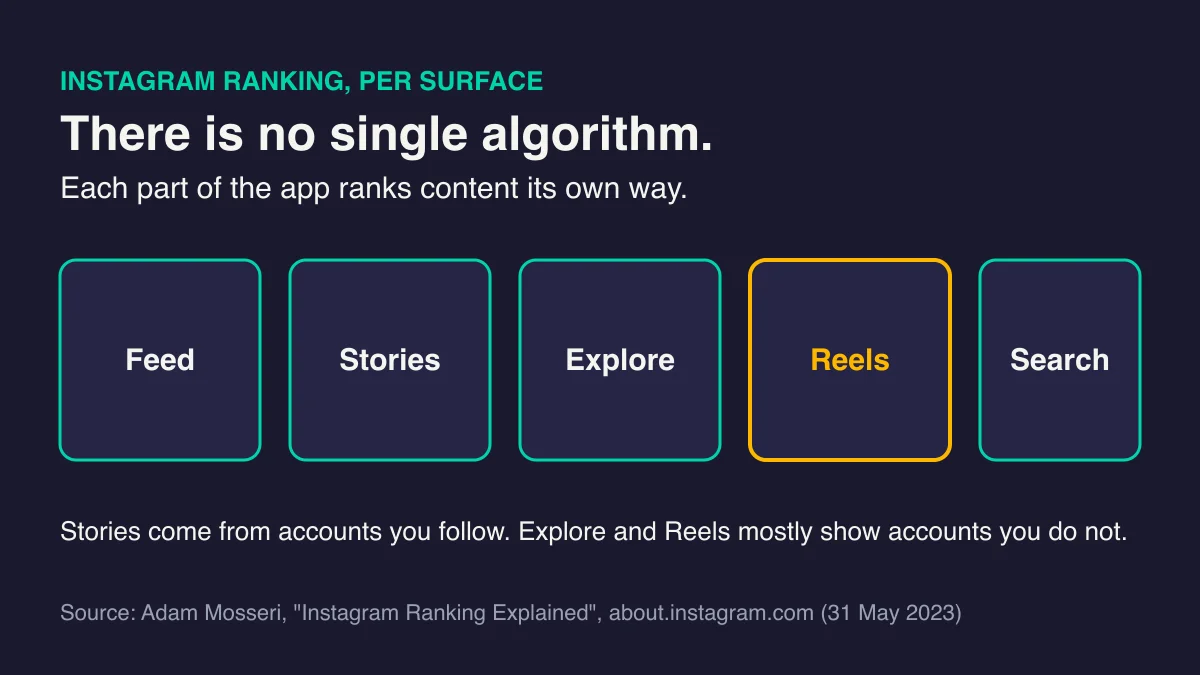
Start with the framing most “algorithm hacks” skip. Instagram says it does not run one algorithm.
In its ranking explainer, Instagram head Adam Mosseri wrote that Instagram “doesn’t have a singular algorithm” and instead uses “a variety of algorithms, classifiers, and processes, each with its own purpose” (Instagram Ranking Explained, 31 May 2023). Feed, Stories, Explore, Reels and Search each rank content differently.
That matters for a faceless page. Your followers see you mainly in Feed and Stories. Strangers find you in Explore and Reels, where Instagram says most of what people see is from accounts they do not follow.
So the first question is never “how do I beat the algorithm?” It is “which surface am I trying to win?” For growth, that is almost always Reels and Explore.
One honest caveat. The explainer was published in 2023, and Instagram has since changed how originality and distribution work. Treat it as the base layer, and the later posts below as updates on top.
Step 2: Learn What Each Surface Predicts
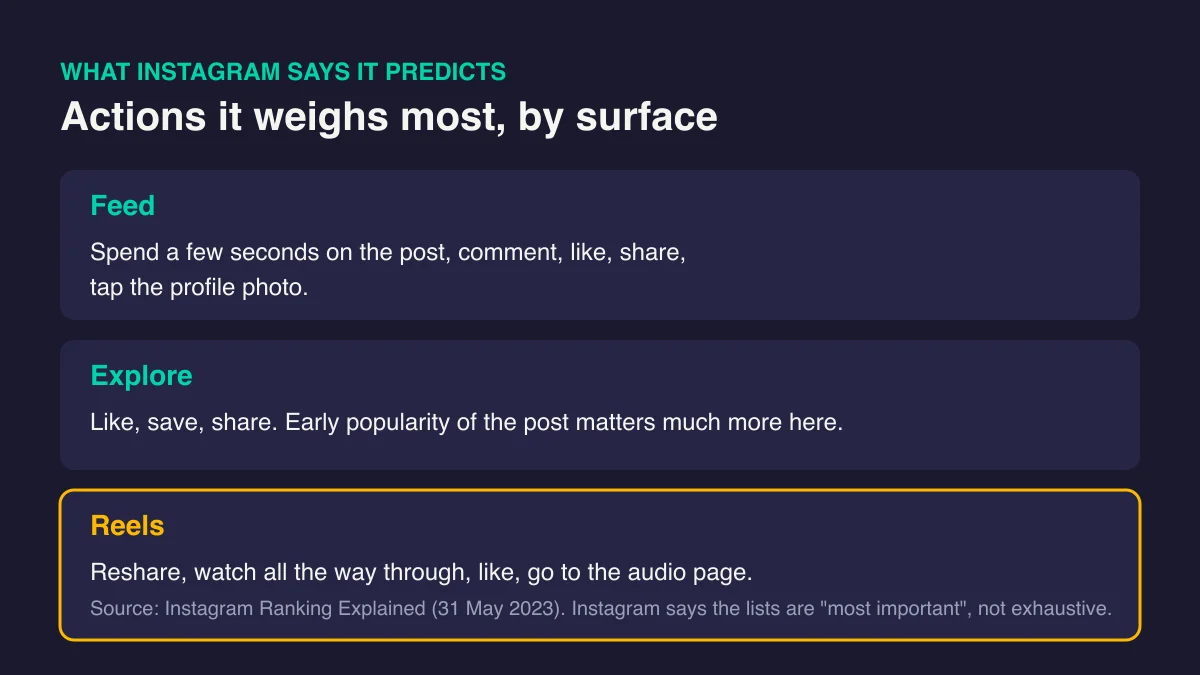
Every ranking system makes predictions. Instagram says it makes roughly a dozen guesses about how likely you are to interact with a post in different ways, and the ones it weighs most differ by surface (same source as above).
Here is what it names, per surface:
| Surface | Actions Instagram says it predicts most | Who sees it |
|---|---|---|
| Feed | Spend a few seconds on the post, comment, like, share, tap the profile photo | Mix of followed accounts, recommended posts and ads |
| Stories | Tap into a story, reply, move on to the next story | Accounts you follow |
| Explore | Like, save, share | Mostly accounts you do not follow |
| Reels | Reshare, watch all the way through, like, go to the audio page | Mostly accounts you do not follow |
Source: Instagram Ranking Explained, 31 May 2023. Instagram describes these as the most important predictions, not a full list.
Read the table as a brief for your content, not a formula. Reels reward a video people finish and pass on. Explore rewards a post people save and share. Feed rewards a post people pause on.
Instagram also says it uses “thousands” of signals, such as when a post was shared and how often someone likes videos. You will never see them all. You can see the handful that match the actions above, in your own Insights.
Step 3: Check Account Status Before You Change Anything
A page cannot grow in a place that will not recommend it. Check eligibility first.
Instagram’s Account Status screen tells you whether your account and content can be recommended. Instagram’s ranking post calls it “the best way to understand if your account and content is eligible to be recommended.” Open it in your settings, or search “Account status” in the settings search bar, since menu wording can shift.
Look for three things:
- Any note that specific content is not eligible for recommendation.
- Any limit on your whole account.
- The option to remove the content or appeal the decision.
If the screen is clean, move on. If it shows a flag, fix that before you test anything else. Our guide on how to check and fix an Instagram shadowban walks through the audit step by step.
Instagram also publishes baseline rules for what it will recommend. Its Help Center page on recommendations says the recommendation guidelines hold content to a higher standard than the Community Standards, because recommended content comes from accounts people have not chosen to follow.
Step 4: Make Every Post Original, Especially If You Are Faceless
This is the step that decides faceless pages. Originality is now a ranking gate, not a bonus.
On 30 April 2026, Instagram extended its originality rules from reels to photos and carousels. Accounts that primarily post unoriginal content in any of those formats are no longer shown in places where Instagram recommends content. The same post says 75% of recommendations in the US now come from original posts (Instagram for Creators, 30 April 2026).
The rules came in stages. Here is the public record:
| Date | What Instagram announced | Source |
|---|---|---|
| 31 May 2023 | Ranking explainer: separate algorithms per surface | About Instagram |
| 30 April 2024 | Original reels replace copies in recommendations; aggregators lose eligibility | Instagram for Creators |
| 30 April 2026 | Same protections extended to photos and carousels | Instagram for Creators |
| 17 November 2026 | Content protection comes to Instagram for eligible creators | Instagram for Creators |
Instagram’s 2026 post gives a clear test for edits to someone else’s content. Ask whether your changes add “real value beyond just simply restating or referencing” the original. New information, context or a point of view counts. Adding a border, watermark, subtitles or a credit in the caption does not.
For a faceless page, original does not mean you must be on camera. It means you made something:
- A voiceover that explains or argues a point.
- Screen recordings you captured yourself.
- Graphics or carousels you designed with new information on them.
- A remix that transforms the source, not a straight re-upload.
If you use other people’s content, Instagram points you to collabs, remix, paid partnership labels, story shares and reposts, which keep credit with the original creator.
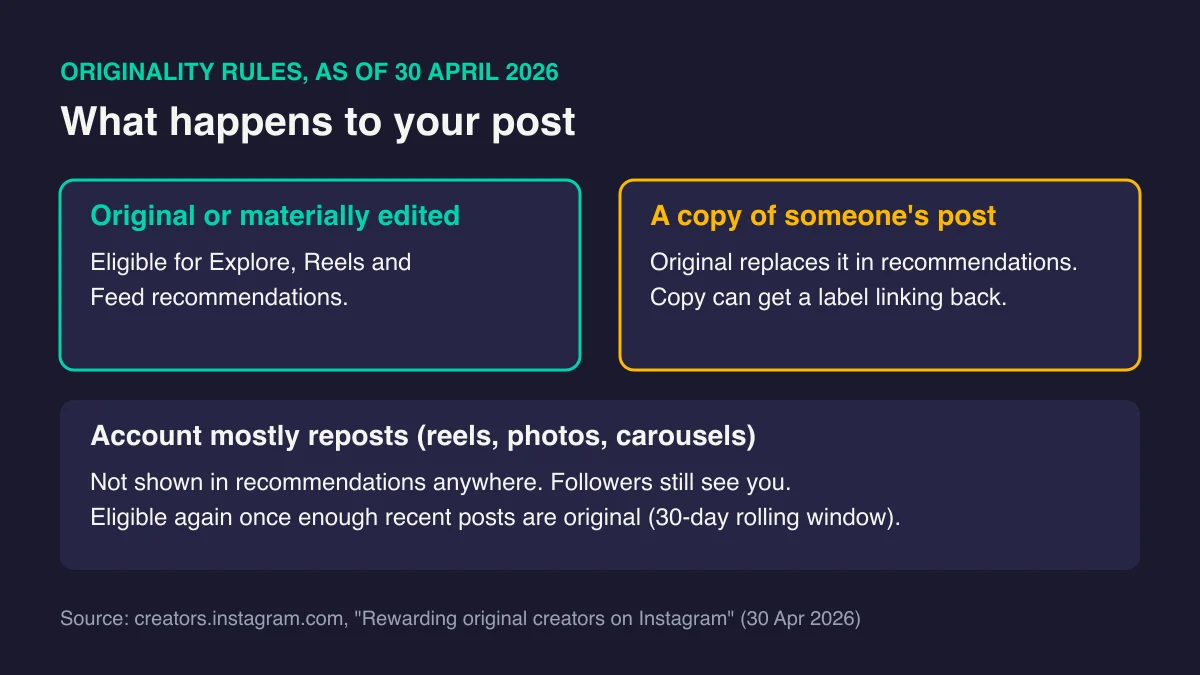
An account made ineligible can recover. Per the 2026 post, it becomes eligible again when a significant share of its recent photos, carousels and reels are original over a 30-day period, calculated on a rolling basis.
Step 5: Design Each Reel for Finishing and Sharing
Now build for the surface that grows pages. Reels are where strangers find you.
Instagram describes how a new reel gets a first look. In 2024 it explained that every eligible piece of content is shown to a small audience it thinks will enjoy it, whether or not they follow you. As that audience engages, the top performers go to a slightly wider group, then wider again (Instagram for Creators, 30 April 2024).
That is a test loop. Your reel has to win each small audience to earn the next one. Based on the actions Instagram says it predicts for Reels, build for these:
- Watch all the way through. Open with the payoff or the question, cut anything that does not earn its seconds, and end on a clean last beat. Our notes on the best Reels length cover how long to run.
- Reshare. Make one point so useful or so recognisable that a person sends it to a friend.
- Like. The lightest action. Do not build the reel around asking for it.
- Audio page visits. Instagram treats a tap to the audio page as a proxy for “I want to make my own.” Reels with a reusable structure invite that. See our Reels template guide.
Keep the idea narrow. One reel, one point, one reason to share.
Step 6: Test Formats Before Your Audience Sees Them
You cannot reason your way to the best format. You have to test it.
Instagram’s Trial Reels send a reel to non-followers first, so a weak experiment does not land in front of your existing audience. Our guide to running Instagram trial reels covers how to run one and how to read the result against your other trials, not your feed average.
Use trials to answer one question per test. A new hook with the same topic. A new topic with the same format. A voiceover against on-screen text. If you change three things, you learn nothing.
Stuck on which lever to pull? Audience.my covers algorithm mechanics, posting systems and growth playbooks for every platform, not only faceless ones. Use it when the bottleneck is distribution, not anonymity.
Step 7: Read Your Insights Like the Algorithm Does
Insights is where you see what Instagram is rewarding. Open it with the prediction table beside you.
For each of your last 10 posts, write down five things:
- Total views, and how many came from people who do not follow you.
- Shares or sends, which map to the “reshare” and “share” predictions.
- Saves, which map to the Explore predictions.
- Watch time or retention, for reels.
- Whether the post was a reel, a carousel or a photo.
Then look for the gap. A reel with strong views from non-followers and few shares tells you the hook works but the idea is not passable. A carousel with many saves and few views tells you the idea is good and the cover is weak.
Instagram does not publish a benchmark that says what number is “good,” so use your own history. Compare each post to your last five. The goal is a trend, not a target.
Step 8: Protect Your Originals and Run the Weekly Loop
Originality now has a second half: defending it. Reposts of your work can cost you reach, and Instagram has added a tool for that.
On 17 November 2026, Instagram brought content protection to eligible creators. Once enrolled, it scans Instagram and Facebook for visual matches to your original videos and alerts you. You then choose one of four actions: track the match, hide it from everyone, add an “original by” credit link, or release it (Instagram for Creators, 17 November 2026). Eligibility is largely based on meeting Instagram’s originality and integrity standards, so another reason to keep your own work original.
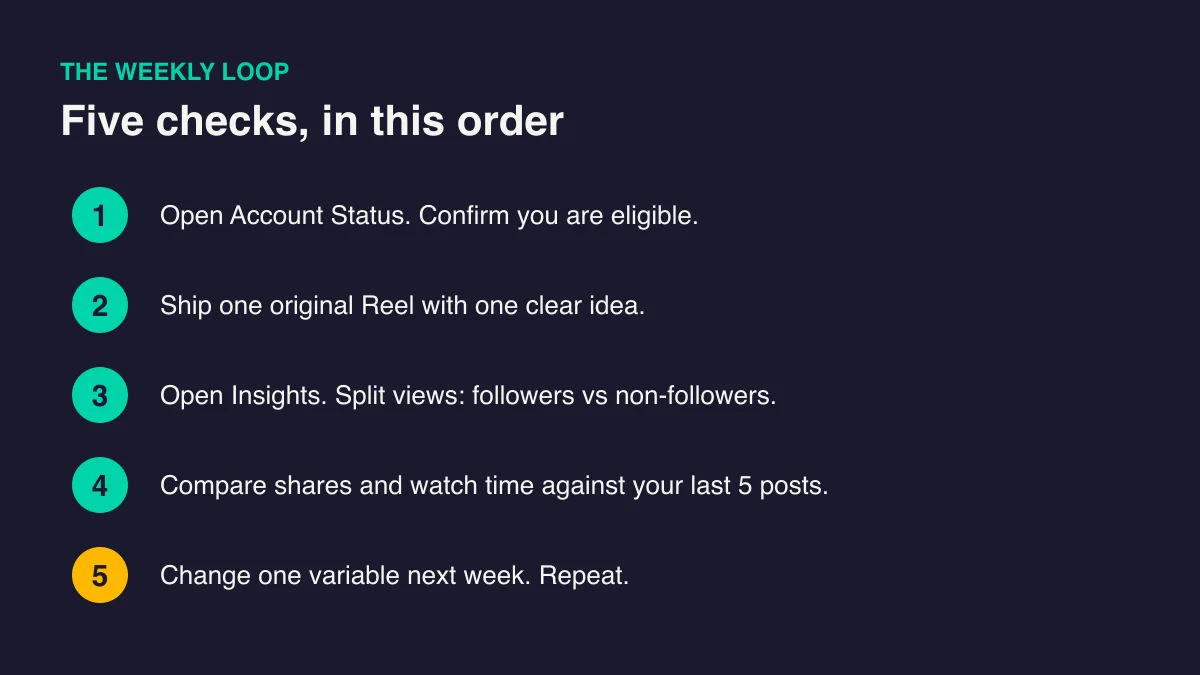
Then run the loop every week:
- Check Account Status.
- Publish one original reel with one clear idea.
- Review Insights for the previous reel.
- Compare it to your last five posts.
- Change one variable for the next one.
Fifteen minutes. Same order. That is the whole system, and it holds up whatever Instagram announces in 2027, because it follows what Instagram has already said it rewards.
Common Mistakes
1. Chasing “2027 algorithm hacks.”
Any guide claiming to know 2027 ranking changes is guessing. Instagram has made no such announcement as of 25 November 2026. Build on the published rules and re-read the Instagram for Creators blog each quarter.
2. Treating a repost with a border or caption credit as original.
Instagram’s own examples of what does not qualify include adding a border, watermark, subtitles or a credit in the captions. If your page runs on curated clips, add real commentary, a voiceover or new information, or use the collaboration and repost tools instead.
3. Judging a post by its follower reach.
Followers see you in Feed and Stories. Growth comes from Reels and Explore, where most viewers are strangers. Split your views by followers and non-followers before you decide a post worked.
4. Changing everything at once.
New niche, new hook, new posting time and new format in one week leaves you with no idea which change moved the numbers. Change one variable per post and write it down.
5. Ignoring Account Status until reach collapses.
Account Status is where Instagram says eligibility is shown. Check it weekly so a limit never sits unnoticed for a month.
Frequently Asked Questions
What is the Instagram algorithm in 2027?
Instagram has announced no 2027 algorithm. As of 25 November 2026, the public record is Instagram’s separate ranking systems for Feed, Stories, Explore and Reels, plus originality rules extended to photos and carousels on 30 April 2026. Plan around those, not rumours.
How does the Instagram algorithm work?
Instagram says it uses many algorithms, not one. Each surface gathers posts, scores signals about the post, the poster and your history, then predicts roughly a dozen actions such as likes, shares and watch time. The more likely and the more heavily weighted an action, the higher the post ranks.
Does Instagram reward original content?
Yes. Instagram says 75% of recommendations in the US come from original posts. Since 30 April 2026, accounts that mainly post unoriginal reels, photos or carousels are not shown in recommendations. Material edits that add new information or a point of view can still count as original.
How long does it take to regain reach after being limited?
Instagram gives no fixed time. For originality limits, an account can become eligible again when a significant share of its recent posts are original over a rolling 30-day period. Check Account Status for your own standing and the option to appeal.
Keep Reading
What to Do Next
Two-question check. Is the constraint anonymity (faceless format, voice-only, no on-camera)? Or generic growth levers (CTR, retention, packaging, topic clusters)? Pick the line that fits.
Free spreadsheet
Compare 75 faceless niches side by side
Sort all 75 by CPM range, competition, and production difficulty. Filter to what fits you and pick one.
Free. No spam. Unsubscribe anytime.
Generic growth? Audience.my owns that
If your stuck point is title, thumbnail, retention, or topic-cluster choice and anonymity is not the issue, Audience.my owns the cross-platform growth workflow.
Open Audience.my →